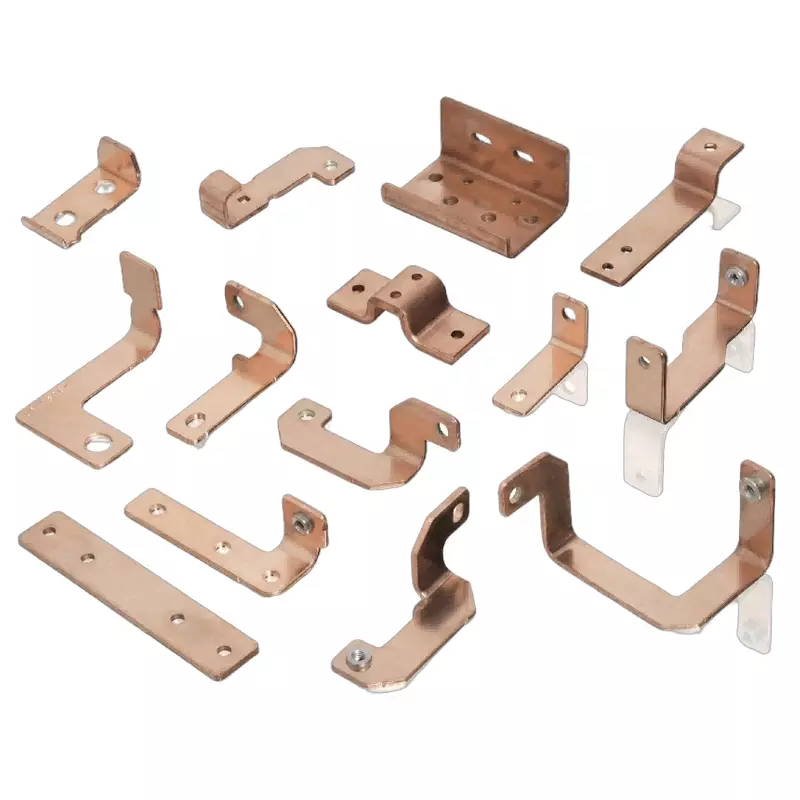
Product Overview
Our battery busbars and integrated injection-molded insulated copper busbar connectors are core components for energy distribution in modern electric vehicles, energy storage systems and high-end industrial equipment. Designed specifically for high-current and high-voltage applications, they not only offer outstanding conductivity and structural integrity, but also ensure the absolute safety and long-term reliability of the system through innovative insulation packaging technology. We offer solutions ranging from standardized designs to fully customized ones to meet your most demanding electrical and mechanical requirements.
Core product line
1. Battery busbar
Material: High-purity, high-conductivity copper (T2 red copper) or aluminum alloy is adopted. Tin plating, silver plating or nickel plating treatment can be selected to optimize conductivity, enhance corrosion resistance and reduce contact resistance.
Process: Utilizing precision stamping, CNC machining and laser welding technologies, it ensures millimeter-level dimensional accuracy and perfect interface consistency, achieving seamless integration with battery modules and BMS acquisition harnesses.
Design: Topology optimization can be carried out based on the layout of the battery pack to achieve a compact structure and balanced impedance electrical connection, effectively managing thermal distribution.
2. One-piece injection-molded insulated copper bar connector
Core technology: Advanced "insert injection molding" process is adopted. The precisely formed copper bars are embedded in specially designed molds and fully coated with high-performance engineering plastics (such as PA66+GF, UL94 V-0 flame retardant grade).
Integrated advantages
Minimalist assembly: Integrating the traditional required "copper bars + insulating sheets + fasteners + manual assembly" into a single component, it greatly simplifies the installation process, reduces labor costs and error rates.
Outstanding safety: Fully wrapped insulation completely eliminates the risk of short circuits caused by vibration, moisture or accidental contact, meeting IP67 or even higher protection level requirements.
Stable structure: The mechanical interlock between plastic and metal provides excellent vibration resistance and durability, preventing the connection from loosening in harsh environments.
Lightweighting: While ensuring strength, optimizing material usage helps reduce the overall weight of the system.
Key features and advantages
Ultra-high current carrying capacity: Optimized cross-sectional design supports continuous current transmission of hundreds to thousands of amperes, with excellent temperature rise control.
Ultra-low contact resistance: Precisely machined surfaces and preferred coatings ensure stable and low-loss power transmission, enhancing system energy efficiency.
Outstanding thermal management: The design takes into account the thermal diffusion path and can work in coordination with the cooling system to ensure stable performance in high-temperature environments.
Comprehensive customization: We offer full-service support from 3D design, prototyping to mass production, flexibly adapting to your battery pack structure, electrical wiring and space constraints.
Strict quality assurance: The entire process adheres to the IATF 16949 quality management system, and the products have passed multiple reliability tests, including vibration, thermal shock, salt spray, and high and low temperature cycle tests.
Typical applications
Internal connection of high-voltage battery packs for electric vehicles
Battery systems for commercial vehicles and electric buses
Industrial and household energy storage systems
Uninterruptible power supply
Renewable energy power generation equipment
Why choose us?
We are not merely manufacturers; we are your partners in power connection solutions. With in-depth knowledge in the fields of metal precision processing and polymer materials science, we are committed to providing safer, more efficient and more reliable connection solutions to help your next-generation energy systems gain a market edge.